
The demolition industry has experienced dramatic shifts as technology, safety, and environmental responsibility have come to the forefront. Methods that prioritize control and minimize collateral damage are increasingly in demand, especially as urban environments become denser and structures more complex. Among the most celebrated advancements is diamond wire sawing, a method recognized for its efficiency and accuracy in cutting through tough construction materials. For contractors and project managers seeking to improve results while meeting current safety standards, learning about diamond wire sawing and providers like Bluegrass Bit is essential.
As demolition techniques evolve, the focus has shifted to minimizing disruption and maximizing safety for professionals on-site and communities surrounding work areas. Diamond wire sawing not only meets these needs but also stands out for its capability to handle challenging environments where conventional approaches might fall short.
Whether the project involves high-rise buildings, infrastructure renovation, or sensitive interior demolitions, professionals are increasingly turning to diamond wire sawing as part of a broader movement toward precise engineering solutions. With reduced vibration and exceptional control, this method not only advances project outcomes but also addresses regulatory and community concerns regarding environmental impact and noise exposure. The transformative potential of this technology is significant. To understand its value, it’s vital to examine what diamond wire sawing is, how it works, and the technological innovations that are propelling it forward.
What Is Diamond Wire Sawing?
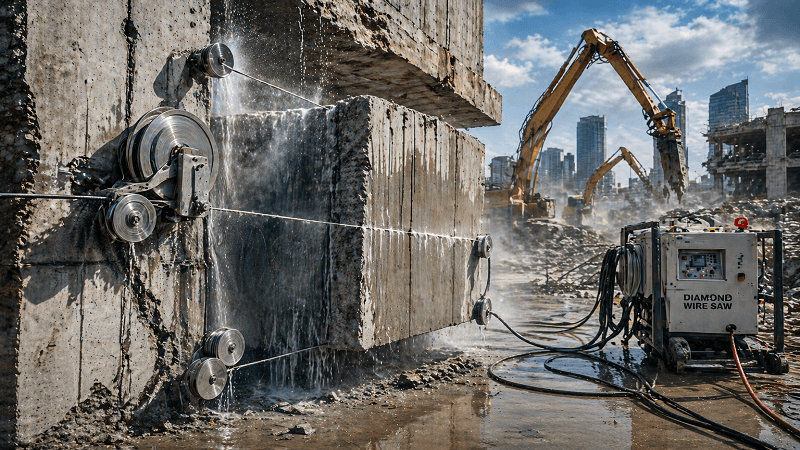
Diamond wire sawing employs a steel wire embedded with industrial-grade diamond segments, looped over pulleys and powered by advanced machinery. The abrasive nature of the diamonds allows them to slice cleanly through nearly any material, including reinforced concrete, steel, and stone. Unlike mechanical breaking or jackhammering, the process generates less vibration, making it especially suitable for projects where preserving the integrity of surrounding structures is critical.
Technological Advancements
Innovation in material science and machinery design has transformed diamond wire sawing into an indispensable tool for demolition professionals. Recent advancements include automated and remote-controlled systems that reduce the need for manual intervention in hazardous or confined spaces. These systems increase safety by allowing operators to manage cutting machinery from protected areas, drastically reducing accident risk. Moreover, the continued improvement of diamond segment bonding techniques has led to longer-lasting wires, further decreasing downtime between operations and reducing overall costs for complex demolitions.
Integration with Modern Construction Techniques
New-generation diamond wire saws are often integrated with intelligent monitoring systems that can adjust tension and cutting speed in real time. This not only extends the life of the wire but also enhances cut precision over vast surfaces. These controls contribute to a smoother workflow, especially in environments where even minor errors could lead to expensive structural setbacks.
Applications in Modern Demolition
Diamond wire sawing is no longer limited to traditional demolition sites. It has found widespread use in critical sectors such as nuclear decommissioning, where clean cuts are mandatory to ensure both precision and safety. In heavy civil projects, it is used to segment bridges, piers, and underwater foundations, proving invaluable where access is restricted or where environmental protection is paramount. The oil and gas industry also relies on this technology to dismantle offshore platforms, as the process can be easily performed underwater or in cramped quarters. For urban demolition, diamond wire sawing provides unmatched control, reducing the risk of damage to neighboring properties and mitigating public safety hazards. It is also well-suited for interior renovation projects, where noise, dust, and vibration must be minimized to avoid disrupting ongoing operations or irritating building occupants.
Safety and Environmental Considerations
Worker safety is a top priority in any demolition environment, and diamond wire sawing shines in this regard. The process produces markedly less dust than traditional mechanical demolition, fostering a healthier worksite and demonstrating compliance with increasingly strict air quality regulations. Reduced noise pollution is another significant advantage, especially for demolitions conducted in populated areas or during sensitive hours. Furthermore, reduced vibration limits the risk of unforeseen structural failures in adjacent buildings, helping demolition projects comply with legal requirements and minimizing costly liabilities. Precision also results in less waste material requiring disposal, directly supporting sustainability goals and reducing transportation and landfill fees.
Comparing Demolition Methods
Traditional demolition approaches, such as wrecking balls, explosive charges, and mechanical crushers, can deliver results quickly but are typically disruptive and lack finesse. These methods often cause collateral damage, create excess debris, and require extensive cleanup and repairs. In contrast, diamond wire sawing excels where detailed results and strict site constraints prevail. It allows for methodical, planned deconstruction even in the most challenging scenarios, often turning what were once high-risk or impossible projects into manageable endeavors.
Future Trends
As environmental consciousness and regulations continue to tighten, diamond wire sawing is poised for further innovation. Efforts are underway to develop wires composed of even more sustainable materials and to enhance the recyclability of diamond segments. Enhanced automation and remote capabilities are likely to increase, resulting in faster, safer, and even more precise operations. Sustainability will drive future research and development, reinforcing the role of diamond wire sawing in responsible construction and demolition worldwide.
Conclusion
The evolution of demolition technologies reflects a broader movement toward precision, safety, and environmental stewardship. Diamond wire sawing stands out as a prime example of this shift, offering robust advantages for modern contractors and project managers. Staying at the forefront of these advances will be essential for industry professionals who aim to deliver optimal outcomes in challenging environments.